The social 'onion' and facilitating vulnerability
Social penetration theory and nurturing a more open group dynamic

Last Letters edition, we explored how to find the line between nurturing psychological safety and connection through vulnerable sharing, and burdening someone with an inappropriate emotional unloading session. (Thanks so much for the wonderful feedback - and remember you can submit a situation or query anonymously for me to explore, here.) I want to go a little deeper on vulnerability and relationship development this week.
Social penetration theory and the ‘onion’ of self
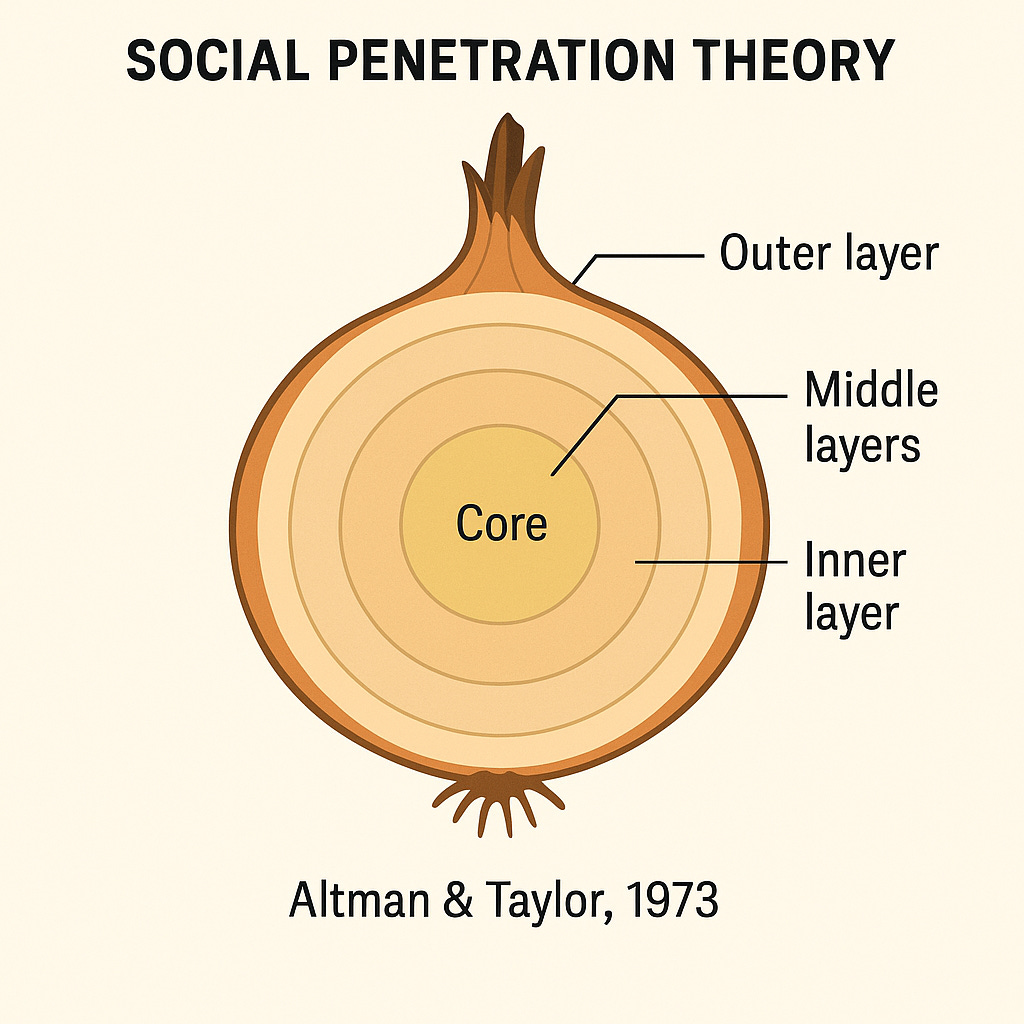
Last week, we considered the potential shift from sharing into oversharing with reference to inappropriateness for context and the level of intimacy in the relationship. A complementary concept to build upon this idea is social penetration theory, which was developed by Altman and Taylor in the 1970s.
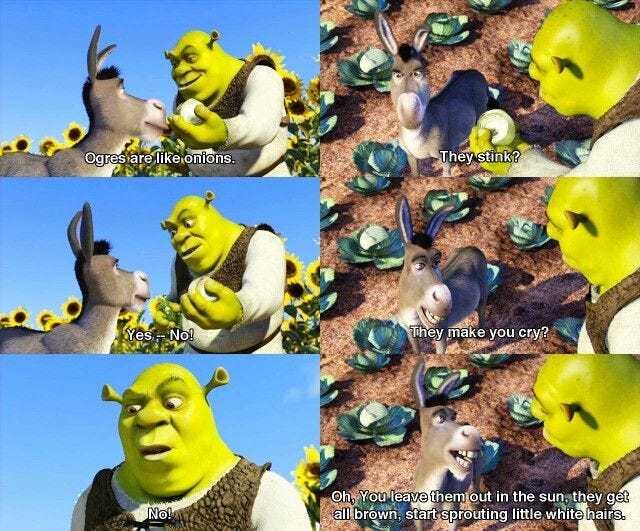
This theory uses a metaphor of people being like onions—I know, I always figured Shrek came up with this first—where the self is comprised of an outer layer, middle layers, inner layers and the core. Each layer reflects a deeper part of self, and as we engage in reciprocal self-disclosure in our growing relationships, we ‘peel back’ the onion. This means moving from the superficial outer layer of information, like our work, where we live, our favourite colour, to more meaningful aspects like our beliefs and opinions about the world, to deeper identity pieces like our hopes, fears, and values. At the core are our most personal and private selves; our self-concept, formative experiences and most intimate emotions.
Typically, the theory states, our relationships will progress as follows:
Orientation: When we first meet someone, we focus on the public self and cautiously share more superficial information.
Exploratory affective exchange: Here, the breadth of topics we discuss expands (e.g., sports, hobbies, travel), but the depth remains limited to more public-self levels.
Affective exchange: Comfort starts to grow between the two parties, and now we will spontaneously offer more intimate disclosures at times that peel back the onion towards more of the middle layers. The relationships at this point could be characterised by more depth, inside jokes, conflict, and rawness, as our closeness increases. Good friends and some romantic partners will sit here.
Stable exchange: No longer a sometimes process, deep self-disclosure is now a much more stable part of the relationship, and our discussions are consistently wide-ranging, deep, intimate, and honest. We steadily share our deepest feelings, beliefs, and experiences with each other, and this level of intimacy is typically maintained only with a select few, such as very close family members, friends, and romantic partners.
If we try to jump straight into the middle layer of the onion when we’re actually in an outer-layer space, we’re pushing things into oversharing territory. Furthermore, it takes two: to progress through these stages, self-disclosure must be reciprocal. Finally, relationships can regress back through the stages in some instances, where relationships start to fall apart, or friendships drift away from each other.
It might be helpful, then, to consider where a relationship stands prior to engaging in a vulnerable share (e.g., are we work colleagues who engage in a wide breadth of topics but don’t tend to go very deep?) and assess the potential for discomfort or relational regression. This framework can also serve as a helpful pulse-check for our expectations of others: For example, considering whether we might be anticipating too much emotional support or space-holding from someone who sits on the outer edge of our onion.
Facilitating vulnerability and encouraging depth
For leadership, this might be a nice observational tool for evaluating the strength of relationships within and across one’s team. Do team members tend to stick to niceties, perhaps suggesting a premature stage of group development? Or, are members broadly happy to share their personal views, feedback, and even concerns (middle layers)? Do they go even further, comfortably offering more intimate emotional experiences and challenges (inner layers)? Perhaps, with keen observation of existing relational dynamics, one can pinpoint where there are opportunities to contribute to progression into the next stages of connection and vulnerability.
When seeking to encourage more vulnerability, it might also be helpful to consider:
Modelling openness (at an appropriate level) to help spark reciprocal self-disclosure that deepens relationships;
Use a variety of platforms and structured processes for communication, so that different people can have their needs for sharing better met. For example, having structured one-on-one check-ins, but also maintaining a WhatsApp group chat for informal discussions at the group level, written 360-degree feedback processes, regular casual face-to-face group meetings, etc;
Be a safe space for opening up: Sometimes, people won’t want to deepen their relationships at work, and that’s entirely valid. Or, they might take a little longer to build strong, safe connections. Engaging in flexible and warm leadership means meeting people where they are and not putting pressure on relationships to evolve in any sort of specific way, but still holding the emotional container as needed.
Encourage boundary-setting to support predictability and safety in the process of relationship development.
What are some strategies you’ve engaged with to help your relationships progress?
Thanks so much for reading my newsletter! I hope you like the new format. I don’t know what I’m doing any more than the next person, so for me, it is more about reflecting and exploring a situation or concept together than offering any kind of concrete answers.
Would you like to submit a situation or question for the ‘Letters’ series? Have an aspect of the human experience you’d like to explore in more depth? Submit anonymously below.
Enjoy this post? It would mean a lot to me if you shared it with someone who may also find it valuable or interesting.
Someone send you this? Subscribe now to get the next one directly to your inbox. Subscriptions are free.
I mostly write about things I find interesting, and often my writing is a way of clarifying my own learnings and insights. Any views expressed in this newsletter are my own and are not affiliated with any other institution, entity or person. Also, these newsletters contain generalised ideas, and none of this material constitutes professional or specific advice of any kind.